Showing posts with label Brooksby. Show all posts

Wednesday, January 12, 2022

Game, set, match: Czar says so long after 10 1/2 years

Australian Christopher O'Connell and his coach, David Moore, encountered a wall
of flames 200 yards (183 meters) ahead while evacuating during qualifying for the
2017 Fairfield (Calif.) Challenger. They quickly turned around and were shaken but
unharmed. Photo courtesy of Christopher O'Connell
   After 10 1/2 years, this is my 3,324th and last post. That's almost one a day, mostly while working full-time. But who's counting?
   At 66 (ugh), I'm ready to move on. I will, however, keep this website active in case anyone wants to peruse past articles.
   I've seen a lot of great tennis in the past 10 1/2 years, but I will most remember the friendly players from around the world and the revealing interviews. Here are some highlights of the past decade-plus:
Dmitry Tursunov, a former top-20 player, detailed
his rigid upbringing in a four-hour interview in 2011.
2017 photo by Paul Bauman
   —Former top-20 player Dmitry Tursunov, a Moscow native who trained in Northern California as a junior and professional, spilling his guts about his rigid upbringing during a four-hour interview in 2011. As Vivian Kensington (Selma Blair) says in the hilarious 2001 movie "Legally Blonde," "Four hours."
   —Australian John Millman, like Tursunov one of the true nice guys in sports, candidly recalling the low point of his career in a 90-minute interview.
   —Millman becoming the first No. 1 seed in the 28-year history of the Aptos (Calif.) Challenger to win the title and shocking Roger Federer to reach the U.S. Open quarterfinals.
   —Strolling on the beach in Aptos as the sun sets on the Pacific Ocean.  
   —Santiago Giraldo, a former top-30 player from Colombia, looking at a ball with a smiley face on it during changeovers in the 2016 Fairfield (Calif.) Challenger to remind himself how lucky he was to be playing professional tennis. Giraldo won the title and retired four years later at 32. 
   —Belgium's An-Sophie Mestach, the world's top junior in 2011, hurting her wrist twirling her racket while bouncing the ball 25 times — yes, 25 times — before each serve.
   —Christopher O'Connell of Australia recounting his harrowing evacuation from Northern California wildfires during qualifying for the 2017 Fairfield Challenger. O'Connell won the title two years later.
Santiago Giraldo displays the smiley-face ball
he looked at during changeovers in the 2016
Fairfield Challenger "to remember how lucky
I am." Photo by Paul Bauman
   —Attending the Australian Open in 2012 — has it really been 10 years? — the U.S. Open in 2015 and 2016, and the BNP Paribas Open in Indian Wells, Calif., annually.
   —Sorry to name-drop, but interviewing International Tennis Hall of Famers Billie Jean King, John McEnroe, Jim Courier, Pete Sampras, Michael Chang, Pam Shriver and Nick Bollettieri. All were gems.
   —The inimitable Wayne Bryan, tennis ambassador, father of Bob and Mike Bryan, and former longtime coach of the Sacramento Capitals in World TeamTennis. Wayne Bryan is smart, funny, exuberant and down-to-earth. Not a bad combination.
   —Serena Williams winning the Bank of the West Classic at Stanford in 2011, 2012 and 2014.
   —Naomi Osaka stunning 2011 U.S. Open champion Samantha Stosur in the first round at Stanford in 2014 as a 16-year-old qualifier playing her first main-draw match on the WTA Tour.
   —Germany's Sabine Lisicki breaking the record for the fastest women's serve (131 mph or 210.8 kph) in a first-round loss at Stanford in 2014.
   —Milos Raonic winning his third consecutive SAP Open title in 2013 in San Jose, Calif. The 6-foot-5 (1.96-meter) Canadian with a pulverizing serve never lost a set in 13 matches in the indoor tournament, which folded in 2014 after 125 years in one form or another.
   —Covering the 100th-anniversary celebration of the Sutter Lawn Tennis Club in Sacramento, Calif. Shriver moderated a poignant question-and-answer session with fellow Hall of Famers Dennis Ralston, Rosemary Casals and Charlie Pasarell. Beforehand, I sat at a dinner table with Ralston, who died 14 months later at 78.
Serena Williams poses after winning the Bank of the West Classic
at Stanford for the third and final time in 2014. Tri Nguyen/
TriNguyenPhotography.com
   —Interviewing San Francisco Bay Area product Brad Gilbert after the renowned coach, author and commentator and former top-five player addressed 125 juniors and parents at the beautiful, stately Olympic Club in San Francisco in 2013. 
   —Sofia Kenin winning a Northern California Challenger for three consecutive years as a teenager, triumphing in SacramentoStockton and Berkeley. Eighteen months after the latter tournament, she stormed to the Australian Open title.
   —Sam Querrey, a 6-foot-6 (1.98-meter) San Francisco native, sweeping the three-week NorCal Challenger swing through Napa, Sacramento and Tiburon in 2014. Querrey had decided to stay on familiar ground rather than try to qualify in Asia on the elite ATP World Tour.
   —Cameron Norrie of Great Britain winning back-to-back NorCal Challengers in Tiburon and Stockton at 22 in 2017 and Taylor Fritz of the United States doing likewise in Sacramento and Fairfield at 17 in 2015. They are now ranked No. 1 in their countries at No. 12 and No. 22 in the world, respectively.
John McEnroe spoke to reporters before a 2014
legends match in Sacramento, Calif. Photo by
Paul Bauman 
   —The spectacular view of the Golden Gate Bridge across San Francisco Bay from the town of Tiburon ("shark" in Spanish).   
   —American Bjorn Fratangelo — yes, he was named after Bjorn Borg — winning the 2018 Fairfield Challenger after almost quitting tennis.
   —American Stefan Kozlov — yes, he was named after Stefan Edberg — reaching the final of the 2014 Sacramento Challenger at 16.
   —Interviewing Jenson Brooksby at 12, CiCi Bellis at 13, Katie Volynets at 15 and Sam Riffice at 15.
   Brooksby and Bellis were voted the Newcomer of the Year on the ATP Tour last year and WTA Tour in 2017, respectively. Bellis, who underwent three operations on her right wrist and one on her right elbow in 2018-19, has not played in 14 months.
   Volynets, who turned 20 on Dec. 31, has climbed to No. 178 in the world. Riffice helped Florida win the NCAA team championship last May, then added the singles title.
   Brooksby and Riffice were born in Sacramento, Bellis in San Francisco and Volynets in Walnut Creek in the Bay Area.
   —Interviewing Stanford alumni Bob and Mike Bryan, Bradley Klahn, Nicole Gibbs and Kristie Ahn. All bias aside, fellow alums are the classiest, most articulate, most introspective athletes I've encountered in 47 years covering tennis. Granted, the tightly wound McEnroe wasn't exactly classy on the court, but he has always been refreshingly candid. Plus, he attended Stanford for only one year.
   Gibbs discussed her battle with depression. Others would have said, "Tennis questions only, please."
At 16, Naomi Osaka stunned Samantha Stosur in the first
round at Stanford in 2014. Photo by Paul Bauman
   True, Ahn flung her racket high into the crowd — accidentally, she said — during the semifinals of the 2019 Berkeley Challenger. But she patiently discussed the incident with a reporter afterward. Others would have hid in the locker room.
   —The sensational final between Smyczek (pronounced SMEE-check) and Kudla, close friends and training partners, in the 2015 Tiburon Challenger. Smyczek saved four match points and Kudla one in Smyczek's 1-6, 6-1, 7-6 (7) victory.
   —Date, a former top-five player from Japan who retired at 26 for 12 years, reaching the semifinals of the Stockton Challenger at 44 in 2015 and losing in the final round of Stockton qualifying at 46. Date was Tom Brady before Tom Brady.
   —The "Gentle Giant," 6-foot-11 (2.11-meter) Ivo Karlovic.
   —The "Little Giant," 5-foot-3 (1.61-meter), 120-pound (54-kilogram) Danielle Lao.
The drive to the Tiburon Men's Challenger offers a spectacular view of the
Golden Gate Bridge from the town of Tiburon. 2017 photo by Paul Bauman 
   —Jan Tiilikainen, after winning the national men's 30 indoor title for the fifth time in 2014 in the Sacramento area, recalling his grueling workouts as a teenager in Finland.
   —Interviewing Wayne Thiebaud, a world-renowned artist who played tennis until the day after he turned 100 in November 2020, on the phone. The gracious, humble Thiebaud (pronounced TEE-bow) died this past Christmas.
   —The "cookie lady."
   —Speaking of sweets ... buying heavenly brownies and chocolate croissants at Fournée Bakery in Berkeley, taking them across the street to the venerable Berkeley Tennis Club and munching them while watching world-class tennis courtside in beautiful weather. It doesn't get any better than that.

Tuesday, January 11, 2022

Brooksby out of Australian Open after testing positive

JENSON BROOKSBY
Photo by Paul Bauman
   Jenson Brooksby's first appearance in Australia will have to wait at least one more year.
   The rising star from Carmichael, Calif., in the Sacramento area has withdrawn from the Australian Open after testing positive for COVID, he revealed Sunday on Instagram.
   Brooksby, 21, wrote that he "was scheduled to fly out (Monday) but my coach and i tested positive for Covid this morning. ... It isn't easy to miss a slam; there are many out there who have suffered worse so I can't complain! I look forward to making my Aussie Open debut next year!"
   Brooksby was voted the ATP Newcomer of the Year for 2021 after soaring from No. 307 to No. 56 in the year-end rankings. He reached the fourth round of the U.S. Open, steamrolling top-ranked Novak Djokovic 6-1 in the first set before the 20-time Grand Slam singles champion dominated the last three sets.
   The Australian Open will begin Sunday at 4 p.m. PST (ESPN).

Friday, December 31, 2021

Brooksby breakthrough highlights top stories of 2021

Jenson Brooksby waits to return serve during practice at the BNP Paribas Open
in Indian Wells in October. Photo by Paul Bauman
   Amid the ongoing pandemic, it was a banner year in Northern California tennis.
   Two players won prestigious ATP awards, and a former Sacramento Capital in World TeamTennis reached the French Open final.
   A coach with strong NorCal ties helped a WTA player soar into the top 10 and reach the title match in the WTA Finals, and two doubles stars qualified for the season-ending tournament for the first time.
   A Sacramento native helped his team win the NCAA team championship, then snagged the singles title.
   And more.
   Here are my picks for the top 10 stories of 2020 with 10 honorable mentions:
   1. Brooksby voted ATP Newcomer of Year Jenson Brooksby, a lifelong Sacramento-area resident who turned 21 in October, skyrocketed from No. 307 to No. 56 in 10 months. He reached his maiden ATP Tour final in Newport, R.I., in his first tournament ever on grass, losing to two-time Grand Slam runner-up Kevin Anderson, and the round of 16 in the U.S. Open, steamrolling Novak Djokovic 6-1 in the first set before falling in four sets.
   Fifteen days after the Newport final, Brooksby beat the 6-foot-8 (2.03-meter) Anderson en route to the semifinals in Washington, D.C. Brooksby also advanced to the Antwerp semis in October as a qualifier.
Mackenzie McDonald lines up a forehand during his first-
round victory over James Duckworth in the BNP Paribas
Open. Photo by Paul Bauman
   2. McDonald voted ATP Comeback Player of YearMackenzie McDonald, a 26-year-old product of Piedmont in the San Francisco Bay Area, underwent right hamstring surgery in June 2019 and fell as low as No. 272 in March 2020.
   This year, McDonald reached the round of 16 in the Australian Open, advanced to his first ATP final in Washington, D.C., and climbed to a career-high No. 54 on Nov. 1.
   3. Ex-Capital reaches French Open final — Unseeded Barbora Krejcikova of the Czech Republic outlasted No. 31 seed Anastasia Pavlyuchenkova of Russia 6-1, 3-6, 6-4 in the first Grand Slam final for both players.
   Pavlyuchenkova, who played for the Sacramento Capitals of World TeamTennis as the world's top junior at 15 in 2006, hurt her left leg late in the second set.
   4. Kontaveit cracks top 10, reaches WTA Finals title match under Tursunov — After hiring coach Dmitry Tursunov in August, Anett Kontaveit of Estonia won four titles, jumped from No. 30 to No. 7 and advanced to the WTA Finals for the first time.  
   Garbiñe Muguruza, seeded sixth, defeated Kontaveit, seeded eighth, 6-3, 7-5 in the final of the season-ending tournament in Guadalajara, Mexico. Tursunov, a 39-year-old Moscow native, trained in Northern California as a junior and professional. 
   5. Shibahara, Olmos qualify for WTA Finals — Doubles specialists Ena Shibahara, who was born in the Bay Area, and Giuliana Olmos, who grew up there, qualified for the season-ending tournament for the first time separately. Second-seeded Shuko Aoyama and Shibahara advanced to the semifinals, while eighth-seeded Sharon Fichman and Olmos were eliminated in round-robin play. 
   Aoyama and Shibahara won a tour-leading five titles, including the Miami Open, in 2021. They also reached the Wimbledon semifinals and Australian Open quarterfinals. Fichman and Olmos won the Italian Open, gained the Australian Open quarterfinals and advanced to the round of 16 at Wimbledon.
Sam Riffice, far left, poses 10 years ago at age 12 with Roger
Federer at the La Quinta Resort in the Palm Springs area. Also
shown are Riffice's coach, Amine Khaldi (second from left), and
Khaldi's friend Steve Mohibi. Photo courtesy of Amine Khaldi
   6. Riffice helps Florida win NCAA title, adds singles crown — Sam Riffice, who was born in Sacramento and grew up in suburban Roseville, won at No. 2 singles and doubles as the top-seeded Gators beat second-seeded Baylor 4-1 in Orlando, Fla., for the NCAA championship. 
   The sixth-seeded Riffice then topped second-seeded Daniel Rodrigues of South Carolina 3-6, 6-1, 6-4 for the singles title.
   7. Wimbledon champ commits to Stanford — Samir Banerjee, who won the Wimbledon boys singles title in July, verbally committed to Stanford.
   Banerjee, from Basking Ridge, N.J., defeated Victor Lilov of Raleigh, N.C., 7-5, 6-3 in the Wimbledon final. Both players were unseeded.
   8. Cal men's coach retires after 29 years — Peter Wright, a Berkeley native who turned 58 on Dec. 8, amassed a 383-256 record at Cal. He guided the Bears to the NCAA Championships 25 times, including a semifinal berth in 2016, and four appearances in the top 10.
   USC associate head coach Kris Kwinta, a 41-year-old Poland native, was chosen as Wright's replacement.
Fiery Danielle Collins exults after winning a point during the final of the
Mubadala Silicon Valley Classic in San Jose, Calif. Photo by Mal Taam
   9. Collins claims crown in San Jose — No. 7 seed Danielle Collins of St. Petersburg, Fla., defeated No. 4 seed Daria Kasatkina of Russia 6-3, 6-7 (10), 6-1 to win the Mubadala Silicon Valley Classic in San Jose, Calif.
   Collins, who turned 28 on Dec. 13, won her second consecutive title and the second of her career. She had surgery for endometriosis, a painful disorder in which tissue inside the uterus grows outside of it, in early April. Doctors removed a cyst the size of a tennis ball from her ovary.
Emon van Loben Sels poses with his trophy
at the USTA Level 1 Spring Individual Cham-
pionships in Mobile, Ala. Photo courtesy of
Emon van Loben Sels
   10. van Loben Sels ranked No. 1 nationally in 16s — The pandemic gave Emon van Loben Sels of Sacramento a needed break last year. He won a USTA Level 2 tournament in Newport Beach, Calif., in February and the Level 1 Spring Individual Championships in March in Mobile, Ala.
   Van Loben Sels' biggest asset is his passion for tennis, according to Kiryl Harbatsiuk, one of his coaches. The high school junior has verbally committed to UCLA.
   Honorable mention — Cameron Norrie, who won back-to-back Northern California Challengers in Tiburon and Stockton in 2017, won the prestigious BNP Paribas Open as the No. 21 seed.
   —Qualifier Mariia Kozyreva, a fifth-year senior at Saint Mary's College in Moraga in the Bay Area, shocked top-seeded Zheng Saisai, ranked No. 75, in the first round of the $60,000 Berkeley (Calif.) Challenger.
   —Katie Volynets, a resident of Walnut Creek in the Bay Area who turned 20 today, won her first professional title to crack the top 200.
   —Former Stanford star Nicole Gibbs retired at 27. The three-time NCAA champion (twice in singles and once in doubles) reached a career-high No. 68 in the world in 2016.
   —Unseeded Usue Arconada won the Berkeley Challenger.
   —The Stanford women ended their longest losing streak in 40 years, three matches, with a 6-1 victory over USC in Los Angeles. 
   —Ethan Quinn of Fresno, Calif., reached the doubles final in the USTA Boys 18 National Championships in Kalamazoo, Mich., with Sebastian Gorzny and in the Orange Bowl in Plantation, Fla., with Nicholas Godsick.
   —Van Loben Sels advanced to the singles quarterfinals and doubles semifinals (with Dylan Tsoi of El Dorado Hills in the Sacramento area) in the USTA Boys 16 National Championships in Kalamazoo.
   —Wayne Thiebaud, a world-renowned artist from Sacramento who played tennis until just after his 100th birthday, died on Christmas at 101.

Thursday, December 23, 2021

The Great Brooksby: He could end U.S. skid, rise to No. 1

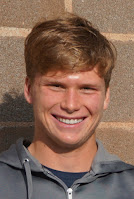
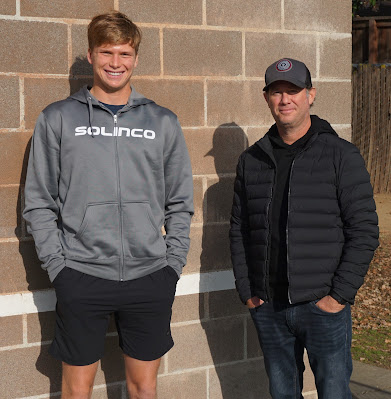
Jenson Brooksby and his coach, Joseph Gilbert, pose on Dec. 11 at the Rio Del Oro
Sports Club in Sacramento, Calif. Brooksby first made an impression on Gilbert
while hitting against the wall at Rio Del Oro at 5 years old. Photo by Paul Bauman
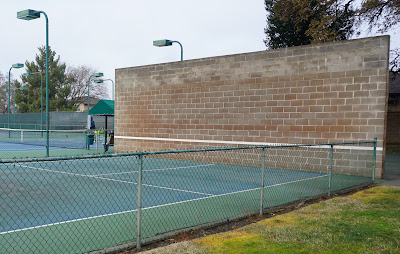
   SACRAMENTO, Calif. — In 2006, director of tennis Joseph Gilbert was teaching a lesson at the Rio Del Oro Sports Club when he noticed a 5-year-old boy hitting against the adjacent wall.
   Lots of players, juniors and adults, do that. But Jenson Brooksby was different.
  "He was doing it with such intensity, such focus that I knew he was imagining himself playing a match," Gilbert (no relation to renowned coach and commentator Brad Gilbert) recalled recently. "Jokingly
enough, I looked at him, and I was like, 'Who you playing?' Within a millisecond, he goes, '(Rafael) Nadal,'" Gilbert added with a laugh.
Gilbert was teaching a lesson on the court at the left while Brooksby was
slugging balls against the wall. Photo by Paul Bauman
   "That was the first time I was really like, OK, I would want to coach this kid, because he was so focused. That's what I think a lot of people lack when it comes to tennis. You have to be out there for three to four hours, and these margins are so small. Throw away athleticism for a bit, throw away physicalness, throw away all this stuff that everybody's attracted to. At the end of the day, you've got to concentrate for three to four hours with not much letdown.
   "When I look at kids, I look at kids who can focus for long periods of time. That number is becoming smaller because everything in our life is about not focusing for three or four hours (laughs), whether it's their Instagram, their phone ... The kids I teach now are 18, 19 years old — they can't watch a movie. It's too hard for them; it's too long. A lot of parents ask me, 'What can we work on?' I'm like, 'Play cards, play chess, play games that last for long periods of time to work on their focus.' Jenson was good at that — he could focus for long periods of time. (Regarding) his attributes, that's a big one."
   Recalled Brooksby, who's as mild-mannered off the court as he is intense on it: "I just loved getting the racket and hitting. I always brought that intensity, even in a situation that doesn't seem you'd need to be intense, like hitting balls against the wall. ... I feel like I've kept that same intensity since I was a young kid to now and (will) into the future."
   Gilbert did indeed begin coaching Brooksby six months after the imaginary Nadal match. Fifteen years later, they're still together, but now at the top level of the game.
   Brooksby, 21, earned the ATP Newcomer of the Year award last week in a vote of players after skyrocketing from No. 307 in the world when he turned pro last December to No. 56 in the 2021 year-end rankings.
   The United States leads all nations with 12 men in the top 100. Three are tennis senior citizens in their 30s: No. 24 John Isner, No. 85 Steve Johnson and No. 96 Tennys Sandgren. Six are middle-aged (23 to 28): No. 23 Taylor Fritz, No. 26 Reilly Opelka, No. 38 Frances Tiafoe, No. 43 Tommy Paul, No. 55 Mackenzie McDonald and No. 66 Marcos Giron. And three are young at 20 or 21: No. 41 Sebastian Korda, Brooksby and No. 68 Brandon Nakashima
   According to the candid, outspoken Opelka, Brooksby could climb to the top of the rankings and end the U.S. men's soon-to-be-19-year title drought in Grand Slam singles.
   "The young guys are better than us, if I'm being honest," the 6-foot-11 (2.11-meter) Opelka, who lost to Brooksby 6-4, 6-4 in the first round in Antwerp in October, told Inside Tennis in October. "Korda is a hell of a player. Brooksby is brutal. He's going to be a big second-week guy. Nakashima is as pure of a ball-striker as there is. The young guys are going to be the guys to beat, from the American standpoint.
   "I'd invest in Brooksby. He's special and could be No. 1. His mind works so differently. He's got this game plan. He sees things so well and is so tricky. Behind the baseline, he reminds me of (Novak) Djokovic. He's got great depth, is a great ball striker, a great mover, (and has) good size and intangibles. He's got this X-factor, his mindset, that could make him a future Grand Slam champion." 
   Brooksby was almost unbeatable on the ATP Challenger Tour, equivalent to Triple-A baseball, in the first half of 2021 as he went 21-3 with three titles. The first loss came after a short turnaround between tournaments in Villena, Spain (elevation 1,657 feet or 550 meters) and Potchefstroom, South Africa (elevation 4,400 feet or 1,340 meters). The second defeat came in a final, and the third came via walkover.
   Brooksby became the first man since Florian Mayer of Germany in 2016 to win hardcourt and clay-court Challengers back-to-back, accomplishing the feat in Orlando and Tallahassee in April. The latter tournament was Brooksby's first on clay in two years.
   All Brooksby did in the second half of the year was:
   —Reach his maiden ATP Tour final in Newport, R.I., in his first grass-court tournament ever.
   —Advance to ATP Tour semifinals in Washington, D.C., and Antwerp.
   —Become the youngest American man to reach the fourth round of the U.S. Open since 20-year-old Andy Roddick in 2002. Roddick won the title the following year, the last singles crown for a U.S. man in a Grand Slam tournament, and was inducted into the International Tennis Hall of Fame in 2017.
   —Knock off three top-25 players (No. 15 Felix Auger-Aliassime, No. 25 Aslan Karatsev and No. 25 Opelka) and three more top-50 competitors (No. 42 Fritz, No. 43 John Millman and No. 44 Alejandro Davidovich Fokina). The ATP on Wednesday chose Brooksby's 6-3, 6-4 victory over Auger-Aliassime in the third round in Washington as the third-biggest upset of the year.
   "I knew I had the game to get to this level, but I'm a little surprised it all came together so quickly, the jump I made after not playing last year," admitted Brooksby, who sat out in 2020 because of turf toe and pandemic cancellations when he was enrolled at Baylor University in Waco, Texas.
   Djokovic praised Brooksby after beating him in four sets in the fourth round of the U.S. Open in September.
   "Brooksby is very talented and intelligent," Djokovic said during his on-court interview. "America has a bright future."
   Brooksby was hardly intimidated by Djokovic or the occasion, steamrolling him 6-1 in the first set in 29 minutes in 23,771-seat Arthur Ashe Stadium, the largest tennis facility in the world.
   "There's nothing he loves more than playing in front of a big crowd and playing on TV," Gilbert asserted. " ... That's where he shines the most."
   Djokovic should be wary if and when he meets Brooksby again, as he and Gilbert learn quickly. Several times this year, Brooksby lost to a player in their first meeting and won the next time. It happened with Bjorn Fratangelo, the French Open boys singles champion 10 years ago. It happened with 6-foot-8 (2.03-meter) Kevin Anderson, a two-time Grand Slam runner-up. And it happened with Karatsev, who vaulted from No. 112 to No. 18 this year to snag the ATP Most Improved Player award.
   Brooksby doesn't just beat opponents. He often leaves them muttering in frustration.
   During his first-round loss to Brooksby in Antwerp in October, Opelka opined that his young countryman is "the best player I've played in my whole life." That includes Nadal and reigning U.S. Open champion Daniil Medvedev. Opelka also marveled, "How could Novak win a game against this guy in the first set of the U.S. Open?"
   During the Orlando semifinals, Christian Harrison fumed, "This guy is a freaking nightmare."
   After Brooksby ripped a lunging backhand down-the-line passing shot that landed on the sideline in the Tallahassee final, Fratangelo snapped: "No ----ing way. ... How easy is tennis for you right now?"
* * *
   Although Brooksby has sprouted to 6-foot-4 (1.93 meters), he is not today's prototypical power player. Rather, he's something of a mystery.
   "I feel like his game is underrated," contended Gilbert, who launched the JMG Tennis Academy (his middle name is Morris) 10 years ago. "I feel like people don't know exactly how he's winning. I feel like they don't know the style. It's just not simple, right? It's not just big serve, big forehand wins.
   "They have a tough time figuring out Medvedev because it's very similar. Medvedev is not a great athlete. How is he winning all the time? But that's OK. They called (Brooksby) unorthodox. The last two guys that got called unorthodox are Medvedev and Nadal. I like those guys (laughs). Being called unorthodox is a compliment."
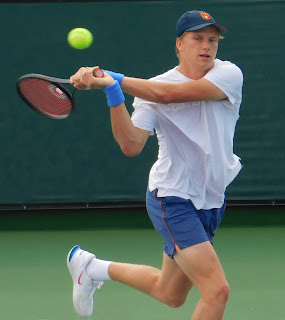
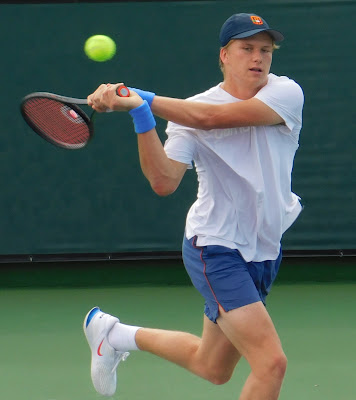
Brooksby has one of the best two-handed backhands
in the world. Photo by Paul Bauman
   So are the comparisons Brooksby has drawn.
   "He has a bit of Djokovic in him; he's got a bit of Medvedev in him; he's got a bit of (Andy) Murray in him," Gilbert said. "A lot of people have compared him to those three players because he's playing a similar stylistic game as them. He's not relying on just (power). He's not playing off of a huge weapon. Murray said it right — he's using slice; he's using different shots. Murray said, 'I enjoy watching him play because it's a little more stylistic, kind of like an art form.' I think it's fun to watch."
   Regarding Brooksby's playing style, Gilbert said: "He has really good hands. He absorbs the ball really well. He has really good feel. He doesn't have too many weaknesses, doesn't have too many holes. He plays patterns a lot. He plays to a strategy, which changes a little bit pretty much every match."
   Gilbert studies videos of opponents the night before a match, tells Brooksby what shots to emphasize in the warmup and meets with his protégé 15 or 20 minutes before the match.
   "I'm like, 'Alright, this is the pattern we're going to play, this is the style we're going to play, these are the shots I want you to use, and this is how you're going to win," Gilbert said. "Then he goes out there, and he has a good ability to focus on that throughout the match."
   Gilbert elaborated on the patterns Brooksby employs.
   "Without getting too specific — people try to dig into the strategy; we try to keep that a little bit close to us because we feel like there (are) only a few guys out there playing the same strategy — we'll talk about when he wants to change direction, what side he wants to play more (against) a certain player, when he wants to be aggressive, what side to come in on, when to use his drop shot, who to use it more against — all those different types of conversations," Gilbert said. "It's a 15-, 20-minute talk before the match. It's not two minutes long. It's like, 'OK, this is where I want you to serve, this is where I want you to hit these shots.' His ability to hit all those shots gives us the flexibility to change the strategy and patterns."
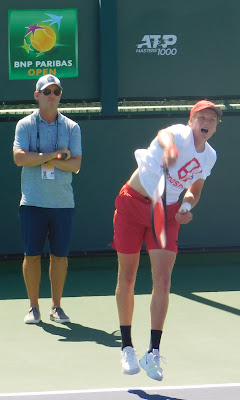
Brooksby practices his serve while Gilbert observes
during the BNP Paribas Open in Indian Wells in Oc-
tober. Photo by Paul Bauman
   Basically, Brooksby wins with metronomic consistency and fierce mental toughness. He possesses one of the best two-handed backhands in the world, a forehand that he says has caught up to his backhand, a great ability to turn defense into offense and a devastating drop shot. Seemingly impervious to pressure, he plays his best on the big points, the mark of a champion.
   "His ball tolerance is obviously high, his consistency is obviously high, but I think it's because he's going after patterns and targets," Gilbert said. "It's a little against what a lot of Americans have been taught — to create that big weapon, to end points fast, serve plus one — big serve, big forehand. It's just a different way to play the game. It's what I believe in — having fewer weaknesses and setting up the points. I'm not particularly worried about having a huge weapon.
   "It matched well for him. If Jenson had to do it based on strength and power and physicality, he's losing a lot of those matches. It doesn't make sense to take a player that's not going to be as big and strong as Serena Williams and tell him to try to outhit Serena Williams. You look at maybe a (Martina) Hingis or a (Justine) Henin, who gave her fits but aren't nearly as big and strong. They're moving the ball around — patterns, different shots, not trying to bang the ball. Those (players) gave her more fits than a (Maria) Sharapova. Sharapova's playing the exact same way (as Williams) but not as big, not as strong, not as physical, not as good at it. Then she goes 0-15 (actually 0-18 during one stretch) against her."
   Brooksby's intangibles, meanwhile, are off the charts.
   "A lot of commentators are saying he's so competitive, and I agree with that 100 percent," Gilbert stated. "Whether we're playing a bounce (short-court) game or he's talking college sports or he's shooting pool, he's so competitive. ... He's one of the (most) competitive kids I've ever seen."
   Brooksby grew up in a competitive environment, both at home and at Gilbert's academy.
   "His mom and dad are super competitive," Gilbert said of Tania and Glen Brooksby. "His mom always had a huge, high belief in Jenson, that he could always do it. She expected him to work hard every time, to compete every time, to be disciplined all the time, to be focused all the time. She really drove that ship."
   Tania Brooksby (née Bentler), in fact, spent a lot of time in the water as a teenager in Van Nuys in the Los Angeles region, earning AAU All-America recognition in swimming.
    "I wouldn't use the word 'intense' (to describe her)," Gilbert said. "She's super loving, super caring but just demanded (Jenson) to work hard. It was about learning and getting better. It wasn't about, is my kid having fun? That's what Tania liked about me. I'm not handing out Jolly Ranchers, playing games and babysitting your kid. I'm not here just for entertainment purposes. I'm here to get better. If your kid doesn't want to get better, I don't want to do it. It's boring for me."
   Like Nadal, Brooksby goes all out on every point. Unlike Nadal, Brooksby is volatile, sometimes flinging his racket in disgust when he struggles. 
   "He doesn't want to give you a point," said Glen Brooksby, a Sacramento anesthesiologist. "Maybe some of that developed because he was always playing up and didn't have a big serve. He wasn't as big and strong and didn't have a putaway shot like the older kids. He had to get balls back, and he wasn't running around the backhand like other kids. He'd always just hit a backhand. He liked hitting backhands. A lot of coaches will say, 'You gotta run around that backhand and hit the big forehand, even at a young age. We never did that; Joe never did that; Jenson never wanted to. I think that helped him develop his backhand.
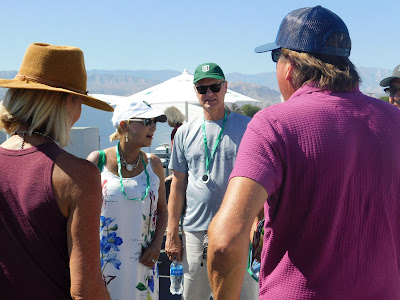
Brooksby's parents, Tania and Glen, chat with friends during the BNP Paribas
Open. Photo by Paul Bauman
   "He had to find ways to win at that age, and it forced him to grind out points, to play hard on every point. He'd always want to break serve. Even if he's up 4-1, he doesn't want to lose a game. He wants to break again. At 5-1, he wants to hold. A lot of players in the pros will pace themselves, especially if they have a big serve. If they get up a break, they'll coast on the return games knowing they can serve it out. He doesn't have that mentality. He's like, 'I want to win every game. You are going to work hard to hold serve against me. I'm going to break your serve every game.' He tries to do that. Obviously, it's hard, but that's his goal, to win every game. And that makes it easier for his serve. It puts less pressure on his serve if he's up a break or two breaks."
   Jenson admits that he hates to lose.
   "There's no tougher feeling for me," he said. "Getting a bad injury can suck, but there's no bigger feeling than losing, especially when I know there (are) things I could have approached better. It sucks, but it's also part of life. I'm more motivated to win than scared to lose."
   Brooksby's hatred of losing, Gilbert said, "motivates him to focus and put his best points together when it counts."
   During the Antwerp tournament, Tennis Channel commentator and Hall of Famer Tracy Austin crowed:  "His mental toughness is incredible. On the big points, he digs in and hits closer to the line. It's really quite impressive."
   Gilbert helped instill that with countless drills at the academy over the years. Games will start at 40-30 or 30-40. After 15 minutes, the loser moves down one court. Or Brooksby will play a set in which each game starts at 0-30 or 0-40.
   "(The coaches) create scenarios where the points are all really important, and nobody wants to move down a court," Glen Brooksby noted. 
   Work ethic? After beating Brooksby in the Newport final, Anderson said he saw Brooksby on the practice court more than anyone else during the week.
   Commentators unanimously say the only thing holding Brooksby back is his serve, but he and Gilbert disagree. Just give him a little more time, they say.
   "I think it's underrated," Brooksby said of his serve. "I know people say it's the speed, but I know I do have the speed. It's not that. Getting my body stronger and more in shape will naturally improve my serve. I feel like the placement is not mentioned."
   Gilbert put Brooksby's serve into perspective.
   "If you know his background, his serve has improved a ton," Gilbert asserted. "He's grown a lot; he was injured for a year. His physicality hasn't quite caught up to his body. Djokovic was similar in a way. He had to pull out of a lot of Grand Slams when he was younger. His serve wasn't a strong point when he was younger.
   "You've seen Jenson since he was a kid. I mean, he was small. He was small his whole junior career, tiny in comparison to everyone else. Now, all of a sudden, he's 6-4. Well, he's been serving as a small guy forever, so it's never been a thought for him to go after his serve so much. A lot of times, it was just like, hey, hit a serve that just doesn't get attacked (laughs) because you're smaller and weaker than everybody else.
   "Even in the gym now, he's not where he needs to be strength-wise, so we've hired a strength-and-conditioning coach, a very good one, Cassiano Costa (of Costa Performance in Boca Raton, Fla.). They've done a very good job with him in a short period of time."
   Gilbert noted that Brooksby "holds a lot, doesn't get broken a ton. His first-serve percentage is high; his spots are good. These are things I didn't feel they were pointing out in his serve (during the U.S. Open).
   "Yeah, if we get bigger and stronger, adding 10 mph (16.1 kph) doesn't seem terribly impossible, considering he's still a boy. He has pimples; he has no hair on his face. He's still maturing."
   Gilbert is more concerned about Brooksby's mental side.
   "He's emotional," Gilbert observed. "There's a positive side to that and a negative side. Djokovic is super competitive, but as he's matured, he's learned how to control it. Jenson has very little control over this. When he's emotional, I've seen it help him, give him energy, and at the same time, I've seen it suck energy out of him. ... I'm working on his emotions constantly."
   Gilbert also coaches pros Katie Volynets, ranked No. 180 at age 19; Govind Nanda, a 20-year-old former UCLA standout; and Collin Altamirano, who in 2013 became the first unseeded player to win the USTA Hardcourt National 18s (Brooksby won the 12s the same year). Brooksby shares a condominium in the Sacramento suburb of Carmichael with Nanda and JMG assistant coach Cam Muller.
   Gilbert's academy — based at Arden Hills, where swimming legends Mark Spitz and Debbie Meyer trained, in Sacramento since 2013 — has sent more than 50 players to Division I schools. Altamirano helped Virginia win the NCAA team title in each of his three years in Charlottesville (2015-17).
   "Joe's a genius," Glen Brooksby proclaimed. "He's one of the top development coaches in the country. Look at the success all of his players have had. All the assistant coaches are good. He selects them; he trains them. And then the parents are dedicated. Most of the kids are home-schooled."
* * *
   How many people — Americans, at least — are named after a race car driver? Glen Brooksby, a racing fan, and Tania christened their only child in honor of British driver Jenson Button, who won the Formula One world championship nine years later. Jenson's middle name is Tyler, hence the nickname J.T.
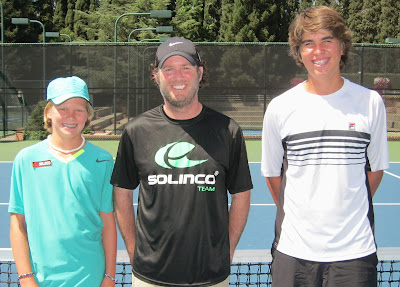
Gilbert poses with Brooksby and Collin Altamirano after they won the USTA
National Championships on hardcourts in the 12s and 18s, respectively, in 2013.
Photo by Paul Bauman
   Glen and Tania took tennis lessons from Gilbert at Rio Del Oro and dragged Jenson along when he was 2. He picked up a racket and began hitting balls. For the next five or six years, Jenson slugged balls off the garage door at home before and after school. 
   "I think he developed good hands because he was doing all kinds of little games," Glen said. "He'd do half-volleys and volleys and then groundstrokes and then move in. I think he really developed kind of a feel for the ball, and he still has a good feel for the ball. He takes pace really well, takes it off the rise when they hit a deep groundstroke instead of backing up."   
   Jenson also played T-ball for a year or two when he was 4 or 5, Glen noted. There were 15 to 20 players on the team, and all played in the field simultaneously. The extra players, including Jenson, spread out around second base. 
   "Some guy would hit it off the tee and lace it down the third-base line, and all the kids would run to where the ball was," Glen recalled. "But by the time they got there, the ball was over here. Jenson was the only one who ran to where the ball would be when he got there. He would field most of the balls because he knew how to intercept the ball."
   When Jenson batted, the coach "would always say, 'You're hitting it like you're hitting a forehand,' Glen said with a laugh.
   After T-ball, Jenson played basketball and soccer in addition to tennis.
   "There were weekends when we were doing soccer tournament, basketball tournament and tennis all in the same weekend in different towns," Glen said. "Something had to give, but it wasn't tennis (laughs).
   "We were seeing the end of the line with soccer because it's really physical. You get a lot of leg injuries. At 11, 12, those boys are really attacking the ball, and I didn't want him to get hurt. We kind of nudged him out of soccer because we didn't want some permanent knee or ankle injury. We knew tennis was going to be his best bet, and that's what he wanted to do mostly."
   Jenson beat Tania and Glen, former USTA League players, for the first time when he was 8 and 10, respectively.
   "We called it the Brooksby Cup," recalled Tania, who owned Bentler Insurance Services until selling it five years ago. "I remember him making me run all over the place. He could just put the ball wherever I wasn't (laughs). Then we took him to dinner."
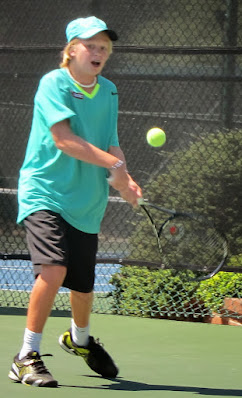
   Brooksby had a stellar junior career, reaching the final of the Little Mo Nationals in the 8s, 9s and 10s, winning the USTA National Championships on hardcourts in the 12s, advancing to the final of the Clay Court Nationals in the 14s and 16s, reaching the USTA National final on hardcourts in the 16s, and winning the USTA Nationals and Easter Bowl on hardcourts in the 18s.
Brooksby, shown at 12, did not run around his back-
hand as a junior, and he certainly doesn't today.
 Photo by Paul Bauman
   Brooksby could have won more junior titles, but that wasn't Gilbert's philosophy.
   "Joe always wanted him to play up," Glen Brooksby said. "He was 11 or something and made the national clay-court semis. Joe's like, 'OK, now he goes to the 14s.' You don't need to win championships at that age. It's not important. It's more the competition. You want to be pushing yourself all the time, and the only way for top players in one age group to do it is to move to the next age group and play the bigger, stronger players. ... 
   "Joe was always looking for that next level, because to him, it wasn't about the juniors. It's about where (Jenson) is right now. He had the vision to do that with Jenson and the vision to create his game. It's Jenson hitting the shots and Joe creating the game style and the way he hits the ball."
   Brooksby reached the USTA National 16s final on hardcourts at 15 and won the 18s at 17. Instead of trying to make it two in a row in the 18s, he won back-to-back $25,000 tournaments in Illinois against budding professionals and earned ranking points. Two weeks later, the 18-year-old Brooksby qualified for the U.S. Open and stunned 2010 Wimbledon runner-up Tomas Berdych in the opening round for his first tour-level win. In the second round, Brooksby led No. 17 seed Nikoloz Basilashvili of Georgia by a set and 4-0 before losing in four sets.
   Forgoing $100,000 for reaching the second round of the U.S. Open, Brooksby enrolled at Baylor in January 2020 but never played a match for the Bears. He turned pro on Dec. 8, 2020.
    Just over one year later, Brooksby is training for his first Australian Open after recovering from an abdominal strain that ended his season two weeks early in November. Nadal is questionable for the year's first Grand Slam tournament, Jan. 17-30 in Melbourne, after testing positive for COVID on Monday. He ended a four-month injury layoff in last week's exhibition event in Abu Dhabi.
   Barring more injuries, Brooksby and Nadal figure to meet somewhere, sometime in 2022. This time, it will be for real.

Thursday, December 16, 2021

NorCal's Brooksby, 21, voted ATP Newcomer of Year

Jenson Brooksby, warming up for a match in Indian Wells in October,
soared from No. 307 to No. 56 in 10 months. Photo by Paul Bauman
   Jenson Brooksby of Carmichael, Calif., in the Sacramento area was voted the ATP Newcomer of the Year, the organization announced today.
   Brooksby, 21, became the first American to win the award since Taylor Fritz in 2016 and the third since 2000. The other is Andy Roddick in 2001.
   "I am extremely grateful to win the ATP Newcomer of the Year award," Brooksby said on atptour.com. "Thank you to all the players who voted for me. It means a lot. It was definitely a fun season, and I would like to thank the fans for cheering me on throughout the year. Lastly, thanks to my team, who supported me through the tough times and the good times." 
   Brooksby stunningly skyrocketed from No. 307 to No. 56 in 10 months. He reached his maiden ATP Tour final in Newport, R.I., in his first tournament ever on grass, losing to two-time Grand Slam runner-up Kevin Anderson, and the round of 16 in the U.S. Open, dominating Novak Djokovic 6-1 in the first set before falling in four sets.
   Fifteen days after the Newport final, Brooksby beat the 6-foot-8 (2.03-meter) Anderson en route to the semifinals in Washington, D.C. 
   Also nominated for Newcomer of the Year were No. 67 Hugo Gaston of France, No. 68 Brandon Nakashima of San Diego and No. 90 Juan Manuel Cerundolo and No. 99 Sebastian Baez of Argentina. Gaston is 21, and the other three players are 20.
   Junior Orange Bowl — Five San Francisco Bay Area players reached the third round in Coral Gables, Fla., and Key Biscayne, Fla.
   Advancing in the singles-only tournament were qualifier Sabrina Lin of Saratoga in the girls 14s, No. 2 seed Kristina Penickova of Campbell and No. 17 seed Sephi Sheng of Palo Alto in the girls 12s, and No. 7 seed Vihaan Reddy of San Jose and No. 9 seed Tanishk Konduri of Cupertino in the boys 12s.
   Penickova won the Eddie Herr International Championships two weeks ago in Bradenton, Fla.

Tuesday, December 7, 2021

Barty voted Player of Year; Stanford commit ousted

Ashleigh Barty won Wimbledon and, for the third consecutive season, ended the
year at No. 1 . 2019 photo by Harjanto Sumali
   International journalists voted Ashleigh Barty as the WTA Player of the Year for the second time, the organization announced Monday.
   Barty, a 25-year-old Australian, won her second Grand Slam singles title at Wimbledon, led all players with five singles titles and ended the year at No. 1 for the third consecutive season.
   Also winning awards were Barbora Krejcikova and Katerina Siniakova (Doubles Team of the Year), Krejcikova (Most Improved Player), Emma Raducanu (Newcomer of the Year) and Carla Suarez Navarro (Comeback Player of the Year). 
   Krejcikova and Siniakova, Czechs who also were voted as the Doubles Team of the Year in 2018, won their third Grand Slam crown in the French Open and triumphed in the WTA Finals. Siniakova finished the year at No. 1.
   Krejcikova won the first three singles titles of her career, including the French Open, and soared from No. 65 to No. 5 in the year-end rankings.
   Raducanu, now 19, of Great Britain became the first qualifier to win a Grand Slam tournament in the U.S. Open. She did not drop a set in her 10 matches.
   Raducanu, ranked No. 343 at the beginning of 2021, ended the year at No. 19. She lost in the first round in San Jose after, at age 18, becoming the youngest British woman to reach the fourth round at Wimbledon.
   Suarez Navarro, from Spain, overcame Hodgkin's lymphoma to play in five tournaments before retiring at 33. She won only one match, against current No. 10 Ons Jabeur in the first round of the Tokyo Olympics, but extended Sloane Stephens and Barty to three sets at the French Open and Wimbledon, respectively.
   Suarez Navarro captured the doubles title in the 2014 Bank of the West Classic at Stanford with compatriot Garbiñe Muguruza.
   ATP Tour — Northern California products Mackenzie McDonald and Jenson Brooksby were nominated for Comeback Player of the Year and Newcomer of the Year, respectively. Results of the playing voting will be announced this month.
   Both players skyrocketed to the top 60 in the rankings, reached their first ATP final and advanced to the fourth round of a Grand Slam tournament. McDonald underwent hamstring surgery in June 2019.
   Juniors — No. 1 seed Samir Banerjee, a Stanford commit from Basking Ridge, N.J., and No. 14 seed Ethan Quinn, a Georgia signee from Fresno, Calif., lost in the first round of the Orange Bowl boys 18-and-unders on clay in Plantation, Fla.
   Switzerland's Kilian Feldbausch, the runner-up in last week's Eddie Herr International Championships in Bradenton, Fla., ousted Banerjee, the reigning Wimbledon boys singles champion, 6-3, 6-2. Henrique Rocha of Portugal edged Quinn 6-4, 4-6, 7-6 (4).
   Michael Zheng, a Stanford commit from Montville, N.J., advanced with a 6-4, 6-2 victory over Alvaro Guillen Meza of Ecuador. Zheng reached the Eddie Herr doubles final with Benjamin Kittay of Potomac, Md.
   In other opening-round matches:
   —Rebecca Munk Mortensen of Denmark topped No. 16 seed Alexis Blokhina, a Stanford signee from Fort Lauderdale, Fla., 6-3, 4-6, 7-5 in the girls 18s. 
   —No. 15 seed George Lazarov of Bulgaria defeated wild card Rudy Quan of Sacramento, Calif., 7-5, 6-3 in the boys 16s. Quan won the Eddie Herr 16s.
   —Adhithya Ganesan of Clarksburg, Md., and Quan beat Gevorg Mnatsakanyan of Gaithersburg, Md., and Jonathan Soeth of Great Britain 6-2, 6-2 in the boys 16s.

Monday, November 8, 2021

Injured Brooksby withdraws from Next Gen ATP Finals

Jenson Brooksby leaves the court after practice during
last month's BNP Paribas Open in Indian Wells. Photo
by Paul Bauman 
   Jenson Brooksby's breakthrough year is over.
   The 21-year-old resident of Carmichael, Calif., in the Sacramento area withdrew from this week's Next Gen ATP Finals in Milan because of an abdominal injury. He also pulled out of last week's Paris Masters with the injury after winning two three-set qualifying matches to reach the main draw.
   The Next Gen ATP Finals features the top eight 21-and-under players of 2021. 
   Brooksby has skyrocketed from No. 307 when he turned pro last December to No. 56. After winning three Challenger tournaments and reaching the final of another in the first half of the year, he advanced to:
   —His maiden ATP final in Newport, R.I., in the first grass-court tournament of his life.
   —Two semifinals on the ATP Tour (Washington and Antwerp).
   —The fourth round of the U.S. Open, drubbing top-ranked Novak Djokovic 6-1 in the first set before the 20-time Grand Slam singles champion dominated the next three sets.
   In the process, Brooksby racked up six victories over top-50 players: No. 15 Felix Auger-Aliassime, No. 25 Aslan Karatsev, No. 25 Reilly Opelka, No. 42 Taylor Fritz, No. 43 John Millman and No. 44 Alejandro Davidovich Fokina.